All Colombians feel a special connection to Wayuu culture—we grow up with it. As life moves through its stages, that bond can deepen. Mine did a few years ago, when my mother, a nurse, was sent to La Guajira as part of government nutrition surveys. On that trip she was able to see up close how Wayuu families truly live—their conditions, their food, their daily life. She came back full of stories and feelings to share. She told me about the desert and the sea, and the beauty this land offers the world. From that trip, she brought me my first Wayuu mochila.
From then on, the mochila became a piece that matched absolutely every outfit—whether I was going out with friends, going to university, or dressing more formally. It carried a special meaning for me, reminding me of my mom.
A few years later, before my parents separated, we took one last trip together along Colombia’s Caribbean coast. We decided to use the opportunity to get to know La Guajira more closely. We wanted to drive our own car all the way to Cabo de la Vela, though we never imagined what an adventure it would be. For some reason we didn’t research the route; we didn’t know which roads to take. We simply set out from Santa Marta toward Riohacha and kept going.
In Riohacha we stayed with a local woman who showed us the warmth and kindness people in La Guajira have to give. After a few days, we began our journey into the desert toward Cabo de la Vela. According to Google Maps, it would take about three and a half hours to reach our destination. We started very early, heading toward Uribia, the Indigenous capital of Colombia. There, in the main square, we met women weaving. They explained the different weaving techniques. We learned how single-thread bags can take up to twice as long as double-thread ones—something that increases their value and significance. We shared food with them and then continued on our way toward Cabo.
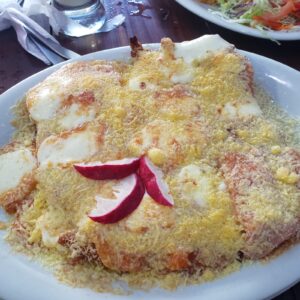
What we didn’t imagine was that a few kilometers after leaving Uribia, the paved roads would end. All that remained were sandy tracks through the desert, with no internet connection and no reliable maps. There wasn’t a set route to follow. We just kept moving forward, trusting that we were choosing the right path to Cabo de la Vela.
Along the way we saw rancherías—the small homesteads where Wayuu families live. Women had set up their crafts, hoping someone might stop to buy. Of course, we stopped at every spot we saw women selling mochilas. We talked with them and, naturally, bought more bags.
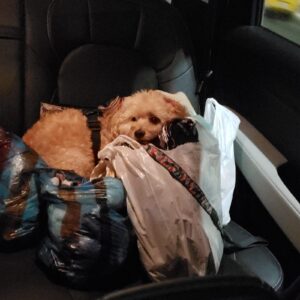
At one of those stops, our truck got stuck in a sand dune. The woman’s sons helped us push the car out. We didn’t know this could happen; we didn’t know how to handle it. The car wouldn’t move forward—it just sank in place—and we thought we might not get it out. But they all helped, without knowing us, without any obligation—just out of their willingness to help. It moved me deeply that people could be so kind to a stranger who didn’t even speak their same language. Some Wayuu women couldn’t communicate with me in Spanish; they spoke through their children, who understood both Wayuunaiki and Spanish.
Thanks to them, we continued our trip toward Cabo de la Vela, happy and still stopping at every ranchería we encountered to look at handicrafts and speak with the community. Still, we reached a point where we didn’t know how to proceed. We got stuck in the dunes two more times. The third time, a helping hand appeared out of nowhere—a driver who traveled daily between Riohacha and Cabo de la Vela. He helped us get out and invited us to follow him. He told us he would show us the correct path to Cabo without getting trapped again, since he drove that road every day and knew where the sand was firm.
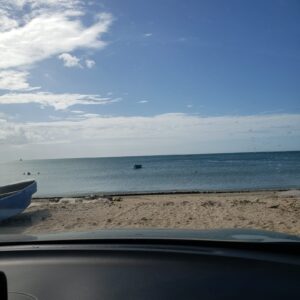
We followed him—his name was Wilmer—all the way until we finally arrived at Cabo de la Vela. This time, on the way, we were able to truly enjoy the landscapes: the desert, the goats, the cacti, the rancherías, and the sight of the sea meeting the sand. When we arrived, we could finally rest, eat, nap for a while in a chinchorro, and refresh ourselves in the sea. It’s a trip that’s hard to describe—a wonder to experience.
We returned the same day, trying not to be caught by night in the desert. We followed other cars heading back toward Uribia, which made it easier to get out safely. It was definitely an adventure—a journey unlike any other in my life—and it left me in love with Wayuu culture.
That road—and the kindness we received—shaped what would become Mochila Wayuu. Today, we purchase directly from Wayuu artisans whenever possible, pay fair, agreed-upon prices, and share measurements for every one-of-a-kind piece. Most of our bags are sourced in La Guajira; some are woven by Wayuu artisans who live in other regions of Colombia. Each mochila carries a part of that landscape, that generosity, and that heritage.
When you carry a Mochila Wayuu, you carry a piece of Colombia’s heart. Contact us for any questions or concerns. Thank you for reading.
Keep reading / shop the collection
Learn more about the region and culture
Explore our latest hand-woven mochilas and carry a piece of Colombia’s heart.